
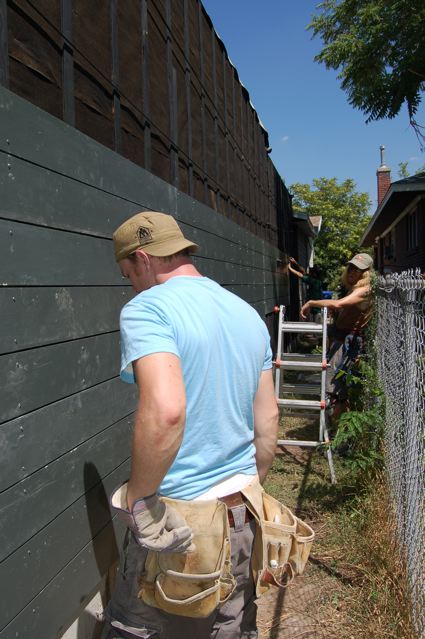
 Our rainscreen siding has been a slow and tedious process. So far we are almost 4 days into it, and we are probably about 3/4 of the way done. Thanks to family and friends, we were able to get a bunch of it done this last Friday and Saturday. We hope it will all be done by today, or Tuesday. I have to admit though, that despite all the hard work, it's worth it. The look it gives the house is very distinct, and it really sets the tone for the whole addition.
For those who have asked about some of the details, read on for a short explanation of exactly what we are doing and why.
Our rainscreen siding has been a slow and tedious process. So far we are almost 4 days into it, and we are probably about 3/4 of the way done. Thanks to family and friends, we were able to get a bunch of it done this last Friday and Saturday. We hope it will all be done by today, or Tuesday. I have to admit though, that despite all the hard work, it's worth it. The look it gives the house is very distinct, and it really sets the tone for the whole addition.
For those who have asked about some of the details, read on for a short explanation of exactly what we are doing and why.
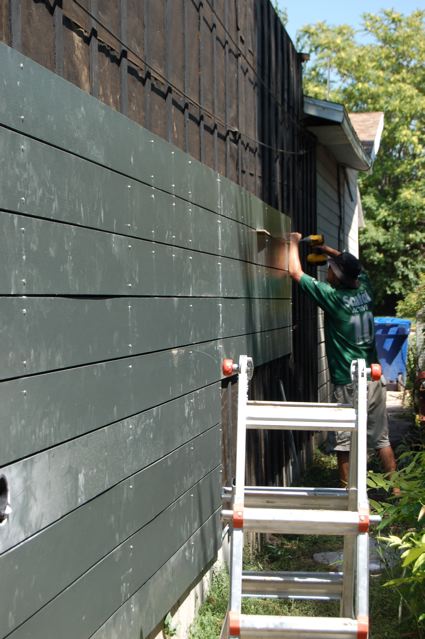 The concept of a rainscreen is not a new one, although it has been utilized much more frequently in modern architecture in recent years. The basic idea is that you start with your exterior surface, and then add your waterproof layer. In our case we wrapped the whole house in Tyvec, and followed that with a layer of 15 pound building paper. We just used the building paper as a layer to black the house out, and not so much for it's waterproofing. To that layer you nail furring strips that will hold your final cladding away from the house. We used 1/2" pressure treated plywood that was ripped into 2/1/2" strips and then painted black. For our project we mounted the furring strip every 16" so we would be screwing into studs. Remember your furring strip layout will determine you screw pattern and your joints. Last you attach your cladding. I have seen some beautiful Ipe rainscreens, but since we were on a budget we went with hardie board. We actually used a 7 1/4" Hardie lap siding mounted with a 1/4" reveal between them. To make our reveals consistent we ripped down some 1/4 masonite to set between the siding as we mounted them. We found the best thing for cutting the Hardie siding was a pair of power sheers. Lastly for screws, we used a #10 pan head self tapping stainless steel screws with a square drive head. They were 1 1/2" in length. We got them online from McFeelys for about $450 for 4,000.
Thats a lot of details, but hopefully that answers some questions for some of you. There haven't really been a lot of rainscreen applications that I know of that have been around for 15-20 years, so how it holds up is still to be seen.
The concept of a rainscreen is not a new one, although it has been utilized much more frequently in modern architecture in recent years. The basic idea is that you start with your exterior surface, and then add your waterproof layer. In our case we wrapped the whole house in Tyvec, and followed that with a layer of 15 pound building paper. We just used the building paper as a layer to black the house out, and not so much for it's waterproofing. To that layer you nail furring strips that will hold your final cladding away from the house. We used 1/2" pressure treated plywood that was ripped into 2/1/2" strips and then painted black. For our project we mounted the furring strip every 16" so we would be screwing into studs. Remember your furring strip layout will determine you screw pattern and your joints. Last you attach your cladding. I have seen some beautiful Ipe rainscreens, but since we were on a budget we went with hardie board. We actually used a 7 1/4" Hardie lap siding mounted with a 1/4" reveal between them. To make our reveals consistent we ripped down some 1/4 masonite to set between the siding as we mounted them. We found the best thing for cutting the Hardie siding was a pair of power sheers. Lastly for screws, we used a #10 pan head self tapping stainless steel screws with a square drive head. They were 1 1/2" in length. We got them online from McFeelys for about $450 for 4,000.
Thats a lot of details, but hopefully that answers some questions for some of you. There haven't really been a lot of rainscreen applications that I know of that have been around for 15-20 years, so how it holds up is still to be seen.